Sunday, 6 May 2012

Butterflies Fly Free

During the winter doldrum months between February and April, we wait impatiently for Spring to arrive. At this time of the year, the Montreal Botanical Gardens closes off one end of their extensive greenhouses and brings in hundreds of tropical butterflies to fly free amongst the plants.  It's a highly promoted and very popular attraction that keeps visitors coming to the MBG during the "no grow" season.

You have to really want to see them to make a visit, as there always seems to be a wait in line to get in (and the children are amazingly patient). It's almost as much fun to watch the people interacting with the butterflies as it is to watch the butterflies themselves. Once you pass through the butterfly proof barrier, people seem to lose both their inhibitions and their sense of decorum as they stand with their arms out hoping one will land on them. And then there are the truly annoying people who don't seem to understand "Don't touch the butterflies" in either English, French, or sign language. (A line drawing of a butterfly held in a hand with a red circle and cross through it is pretty explicit I'd say).

However, despite, the lines and the crowds, it is a truly magical experience, and an extremely sad one too. We shouldn't have to pay to stand in a crowded greenhouse to be with one of nature's most endearing creatures; we should be restoring their habitats, not spraying every caterpillar in sight, and then perhaps we could experience these beautiful ephemeral insects where they should be seen - in their natural habitats.

Here are some shots of the butterflies.

Myscelia ethusa (Mexican Bluewing )

The Tailed Green Jay (Graphium agamemnon).
Native to India, South East Asia and Australia.

This is a blue butterfly (I think it's the Blue Morpho).
When it's not flying it folds its wings and the brown underside provides camouflage.
Native to Central and Southern America it is severely threatened in the wild.
This Blue Morpho has landed on David's shirt.
Papilio Déiphobus Rumanzovia - Male.
 It can be found in Australasia (especially Indonesia).


You get a sense of how glorious the butterflies are through the pictures but there's nothing to compare with seeing them in flight. For example, the Papilio Deiphobus Rumanzovia is a bit boring in the photograph, but it is transformed in flight. Take a look for yourself.  Notice the "don't touch the butterfly" sign at the base of the plant (that is if you can tear your eyes away from the butterfly).

Here's a better view of the underside of the wings of the Papilio Déiphobus Rumanzovia.  I don't know what the plant is that this one is feeding on, but I've seen other photos of it on the web drinking at this flower. It must be a particular favorite of this species.

This is the Malabar Tree Nymph, or Rice Paper (Idea malabarica) butterfly. It can be found in Southern India and South East Asia. Notice the way this one is perched on the citrus flower rather than flapping its wings. I'm not sure if that's because some species like to drink on the fly or just because there really isn't a place to perch on some types of flowers. Hmmm, that's a good question to ask a butterfly expert.

The next butterfly is the Birdwing (Troides rhadamantus). This is a female. You have absolutely no idea how stunning the underside of Birdwing is from the top! Watch the video below and you'll see what I mean.


This is the Birdwing sipping the nectar from what I think is a lantana. The yellow and red body is a startling surprise.

What you see here are mostly the white butterflies that actually play together in flight. Sometimes, 2 or 3 of them will appear to perform an aerial ballet. The blue butterflies also play in the same manner, as they are in the same family.

This was the 15th year the MBG hosted the Butterflies Go Free exhibit, and this year they divided it into two exhibits:- the butterfly house with butterflies that fly during the day, and at the other end of the greenhouses was the moths that fly at night. Of course we didn't get to see many moths as it was daylight when we visited, but here are 2 examples that were resting. If these 2 were anything to go by, the moths can certainly give the butterflies a run for their money in terms of sheer spectacle.
The Cobra Moth (Attacus atlas). Native to South East Asia, the Cobra moth is considered one of the largest in the world. It is a silk producing moth which This moth has no mouth parts and only lives for 1-2 weeks. Just enough time to reproduce.
Cercropia moth (Hyalophora cecropia). The largest of the North American moths, it too has no mouth parts and lives for 7 to 10 days.

P.S. To enlarge a picture, simply click once on it (thanks to my clever husband for filling me in on that little secret).

Friday, 27 April 2012

Stairway to Heaven - Part 2

We've looked at one set of steps that came with the lot. There is also another set that goes down past the Lake Lookout Garden to the dock.  We call them the Dock Stairs (perhaps if prizes were awarded for imagination we might have put more effort into naming them).  These are also very old, but despite the fact that they are falling apart they are still serviceable.

Here is the base of the dock stairs.

P.S. I'm having a few technical difficulties today, so this post is still to be continued. Rest assured, we'll get to the top of the stairs in another post.

These steps don't exist anymore. They were so rickety, they were removed (much to my chagrin). 
Notice the way that tree seems to be growing in a crack in the rock. It's one of the younger oaks).

Here's a view of the dock stairs from the side. 
Note the lovely big rock in the background. That's where we moved one of the cinder blocks to.


And here's a view of the stairs from the front. It's hard to see, but the steps are made of sawn off lengths of railway ties. There's lots of wild grass (which is probably sedge rather than grass) growing in between, and there have been known to be yellow jackets nesting underneath - makes for exciting journeys up and down the stairs!
Note the shady spot at the top. It's always lovely and cool there and you can sit and survey the lake.

Sunday, 8 April 2012

The Garden Database - by David Kelly


When I think of the hours of toil and frustration that I have spent so far in the creation of my Gardening database, I have, from time to time, questioned my motives. What really is the point of this complexity? Who in their right mind would go to this trouble if they weren’t being paid? As far as I can figure, it was born purely of my own necessity. The garden would obviously flourish or perish regardless of a database. Much of it boiled down to my lovely wife, to whose standards I felt compelled to rise.

You see my wife is British by birth, and still retains her accent. Months and months before we had even met face-to-face, having only spoken by phone, she had lured me in with her lovely accent and her obvious intelligence. While the accent alone is lovely, when spoken with Gardener’s Latin, the combination can be intimidating. Thus it seemed to me there was a necessity to rise to her level. I couldn’t do anything about the accent, but I could certainly expand my lexicon to encompass some Latin taxonomy. With the database, the correct botanical names for our garden specimens are right at my fingertips.

My wife also has a better memory than me, or at least sets the standard to which my memory is to be measured! With a database, we can agree on the facts, they can be meticulously recorded and yet retrieved in an instant. In the years before the database I would struggle and be frustrated trying to remember from year to year where a particular specimen was planted. For even with our modest beginnings, we had five different planting sights.

A final necessity, for which my wife can claim no credit, is satisfy my meticulous nature. I do love the minutia of collecting the details and presenting them in a consistent and professional format. Digging through some old gardening materials, I recently came across some lists and journals that I had made as a teenager back in the early 80’s. I’ve always been this way, now it just looks more sophisticated.

These were plans, notes and journal entries from my parents garden in Montreal in the 80's
This is the homepage of the database that I have created now. A place to house all sorts of garden related data.


A sample Specimen record from the garden database.

Wednesday, 4 April 2012

Spring!

Twice a week I have a lovely walk to work. I guess I should explain that sentence. As a bookkeeper I have clients in many different locations. I like it that way. It means I'm never bored.  Twice a week I go east to see a client in Leslieville and I've grown to enjoy the little walk between the streetcar stop and the office.

It's a strange neighbourhood. As it is still somewhat reasonable, it has undergoing some gentrification and this is evident as many of the little semi-detached homes are being renovated, often showing signs of an architect's influence.  Some have gardens that are little gems. Lawns still exist, but are getting smaller and smaller.

Spring has come early this year, and we had 2 weeks of over 20 degree temperatures. Gardens have exploded with blooms. And of course it was followed by a 20 degree drop in temperature. Some of the buds have been blasted by the cold, but at least it has slowed down the blooming to a more sedate pace. Perhaps the Spring will last a bit longer now before erupting into summer.

Here are a few of the gardens along my walk.

This is a lovely little elevated front garden. The urn usually has something seasonal in it, and there's a very nice topiaried cedar. You can see some pale blue Chinodox in the foreground and there's actually a helleborus behind the urn.
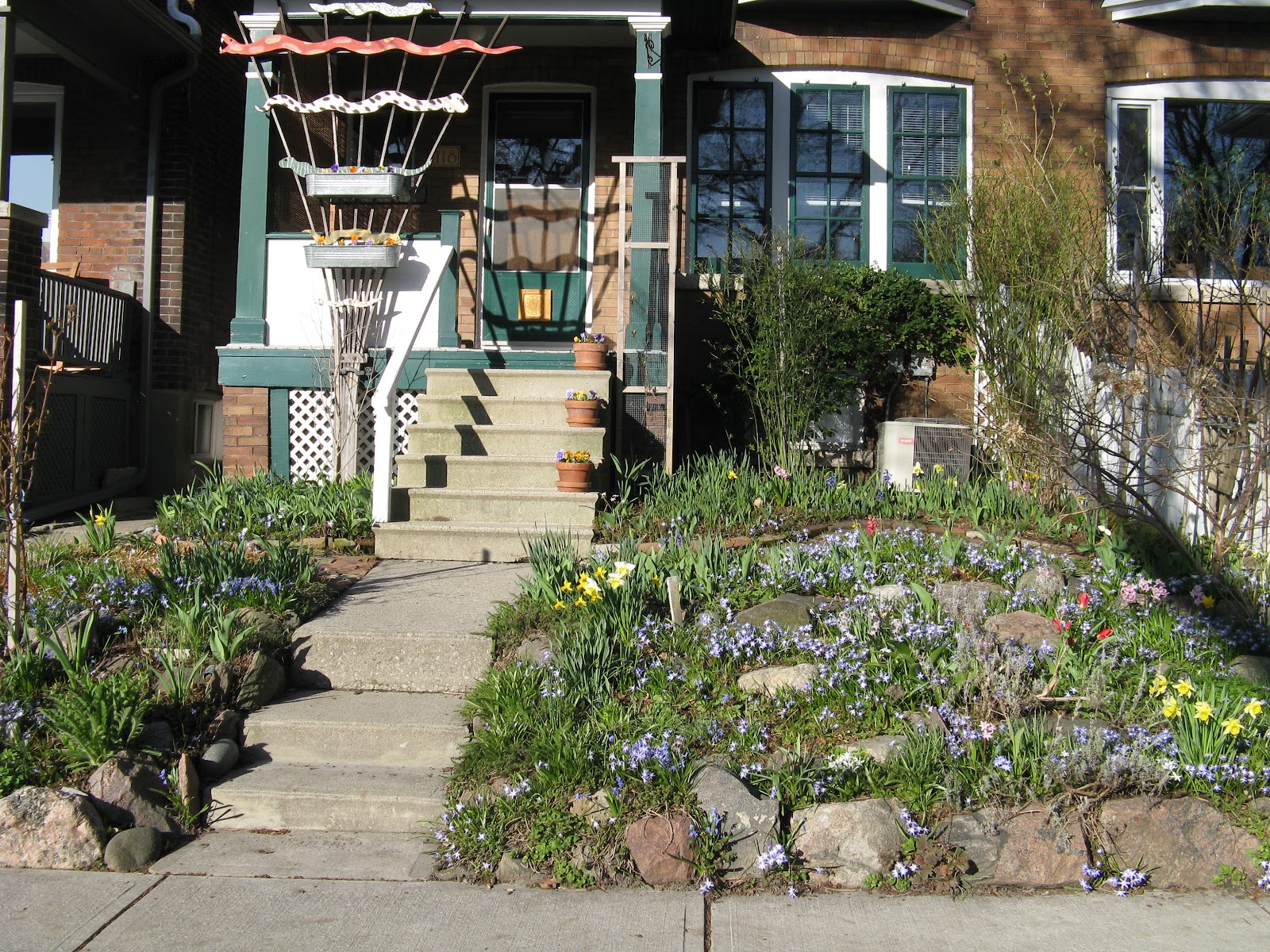
Right next door is this charming little garden.
It doesn't matter what time of year, this garden is packed with flowers. I'm not sure how they get everything in. At the end of last year, when most gardens had long finished, this garden had a late blooming Aconitum (Monkshood ) snuggling up to the dried flowers of a Hydrangea that had turned a beautiful coppery colour. It was sensational. I also love the playful and very creative handmade trellis. This is one of my favorite gardens on my walk, and I look forward to seeing what has come up.
This delightful postage sized front yard is packed with plants.
 There's a weeping larch (perhaps Larix decidua pendula) in front of the air-conditioning unit, that's just starting to leaf out. Next to it is a burgundy Helleborus niger. In front of it there's a tiny flowering quince (Chaenomeles) that's just budding out. Chaenomeles are very early bloomers. Watch out when you see Forsythia in bloom, Chaenomoles are not far behind. There are also some interesting dwarf evergreens. I can see a thread leaf cypress Chamaecyparis, and a small Juniper. I think I also spotted a rose, a tiny leaved Euonymus, and even some Vinca Minor. And there's even some bare ground, that I'm sure will sprout some surprises as the season progresses. Note the problematic garbage pails, that are Mayor Miller's legacy to the City of Toronto. Now every household has to have 3 separate garbage receptacles to put their garbage into for pick up. They are huge and unsightly. I'm glad I don't have to deal with them!
Here's a close up so you can see the individual plants better.
 Here are a few more gardens from the next street over. I don't walk down this street regularly, but it was a nice day and as I had the camera with me I took the opportunity to snap some gardens that interested me.

This is an obvious renovation. The large grasses compliment the design. I think they are Miscanthus sinensis "Gracillimus"
I sense a landscaper designer's hand in this little garden. Multiple plantings of sculptural plants and lots of mulch.  I think it may develop more interest as the year progresses.
I can definitely see the Landscaper's hand in this one! Lovely clean lines.
I love Forsythia. It is one of the best harbinger's of Spring.  There's also a lovely drift wood bench here behind the daffodils.  The garden would benefit from some screening as the ubiquitous garbage receptacles really detract from the over all effect.
This lovely garden is on a corner lot. The photo doesn't do it justice. There are some lovely evergreen's here. Let's hope they're all slow growing!
Here's the same garden from the corner. I'm not sure about the scale of the grasses (probably Calamagrostis acutiflora "Karl Forester"). The plants are very close to the house, and seem a bit dominant, but the curly willow is sensational here. Once again, there are at least 3 conifers that I can see - all cheek by jowl in a very narrow space.
I hope you've enjoyed walking to work with me. I'll repeat the process later on when the summer gardens have started.


Sunday, 1 April 2012

Stairway to Heaven

If you recall Kelly Gardens is very hilly.  The previous owner was either a bit handy or bit parsimonious, or perhaps a bit of both.  He built lots of things out of scraps that he had probably gotten free. There are benches, stairs and bridges, all of which are in various states of decay.

In the above photo, you can see some benches he made from two cinder blocks with a piece of lumber fastened across the top. He placed 3 of these lovely seats around a fire pit.  The lumber has rotted a bit (not surprisingly since they are probably 25 years old) but they still work, and we moved one of them to overlook the lake. Behind the bench, you can just see one of his staircases in the distance.

A closer look at the staircase from the picture above. As you can see, he just sawed lengths of railway tie and nailed them to strips of wood. You can just see at the bottom the wood has snapped.  They don't look very safe do they?  David tried to fix them, but I don't think they're much better as they aren't even, and as there's no hand rail they are not easy to negotiate. It is remarkably hard to make stairs.

David tries out the new stairs. They certainly look better!
These stairs go down to a little valley that we call the Deer Run (yes, I know I've still got to get that map posted so you can see where all these places are.)  At the top of this set of stairs is a smaller set which are constantly in the shade and have been come beautifully covered in moss.

Notice the little fern that's seeded itself in the gap between steps
This is a delightful location for a planting. We decided that this Japanese Forest Grass, Hakonechloa macra aureola would look splendid here as it tolerates the shade. We ended up planting 3 plants here but only 2 have survived.  Hopefully, as they get older, this grass will end up having a waterfall effect edging the stairs.

To be continued...

Thursday, 29 March 2012

Stop the Presses!

I was searching for photos for the next blog post and what do you think I found?  A picture of the birch that had been gnawed by the beaver and finally fell on the Iris.

the birch is on the far left and the you can just about see the beaver damage at the base.
It still amazes me that the birch fell, but perhaps it was helped by a deer or bear!

Monday, 26 March 2012

Canada Blooms 2012

March means Canada Blooms, a perennial favorite of the Kelly Gardeners. It is an annual garden show hosted by The Garden Club of Toronto and Landscape Ontario.  After a long hard Toronto winter, Canada Blooms is always a welcome treat, and it heralds the many joys of a new growing season.

Ahhh, those were the days when the show was held in the depths of the Convention Centre on the South side of the railway tracks. As you came through the entrance doors the smell of Spring flowers literally assaulted your senses.  And the excitement just seemed to mount as you descended down the 2 flights of escalators to the entrance to the show.  Finally through the doors and you were swept away by the exhibits.  There were feature gardens by professional landscapers; exhibits of the latest trends in plants; booths set up by Professional Organizations and Societies of all kinds; Canada's largest floral competition; talks by professionals and a market place where you could shop till you dropped.  Over the years, the show got bigger and bigger. By the time you finished the show, you just wanted to put your feet up and have a nice cup of tea.

In 2010 the show moved locations to the Direct Energy Centre at Exhibition Place. It's not the same. The biggest difference is the smell. You just don't get the same blast of scent when you walk through the doors. And this year Canada Blooms amalgamated with the National Home Show, and it is now one MEGA show, at least four times bigger and lasting twice as long. Of course this means that some of the smaller merchandisers just can't come. Ten days is a long time to commit to a show. And it's really hard for the floral competitions as it is a bit of stretch for cut flower arrangements to look good for10 days.


In the past, there were many feature gardens built by larger professional landscapers who created spaces suitable for outdoor entertaining. This could include a dining area; a lounging area, often complete with flat screen TV or fireplace; or perhaps a kitchen or bar.  This is great if you have no bugs, and is certainly interesting and something that one could aspire to, but is definintely not "must have" for the Kelly Gardeners.

This year there were fewer such large, ostentatious displays.Here's my favorite for its elegant simplicity.
"Dinner Party" by Allweather Landscape Co.

One of my favorites this year was the "International Garden of Taipei, Taiwan" garden by Ron Holbrook. Unfortunately, I'm limited to uploading Youtube videos, so if you want to see some videos of the Taipei garden please visit the following links:http://vimeo.com/38699636
http://www.stylegui.de/newcacom/newca-com-taipei-garden-at-2012-canada-blooms-6036814

The garden was chock full of orchids and also featured the "must have" plant of the year:


Medinilla magnifica a native of the Phillipines
What I liked the best was the clever use of boxwoods to emulate tea plantations, seen here planted with phalaenopsis set out like bedding plants!

There were also a number of incredibly creative gardens. My favorite was the Reford Gardens feature garden, Surface Deep by Asensio Mah, which won the prize for the most imaginative garden at the show. 
Surface Deep

And then there are the themed gardens that I don't quite get the point of. This year's was the Juno Rocks gardens:  four gardens inspired by Juno Award winning performers. Perhaps if I was actually familiar with these performers' work, I would have appreciated the gardens more.

We did have fun though. We met Becky Fox (the Editor of Garden Making) again, and once more we were struck by how wonderfully genuine and self-effacing she is.  We had watched her latest video the night before and we told her what a lovely job she had done introducing the 15 new and noteworthy plants that were featured at the Garden Making Booth. She was touched by our praise as she doesn't find making videos easy.  If you want to see for yourself, visit www.gardenmaking.com and you can watch the video and see the booth.
Garden Making Booth at Canada Blooms

But the real highlight of the show for me was the Rose Garden ...  make that 2 rose gardens.  Very simply 2 fifteen foot square beds, crammed full of roses! Mmmmm, wonderful.

Roses in March!
I really love roses. Even though they are too fussy for our climate and they are a magnet for all kinds of pests and diseases, nevertheless, there's something magical and deeply romantic about the rose. And they beg you to stop and smell them. I do hope we'll be able to grow roses on our lot.

So, why do we go to Canada Blooms (especially now the tickets are $20)?  I don't know. Perhaps it is because after a long hard winter, we are anxious to experience a bit of Spring. Perhaps we hope to be inspired by new ideas. Every year we say we won't go again next year. But every year we do.  The count down begins.... Dare I say that I'm looking forward to Canada Blooms 2013 as a welcome harbinger of Spring.