Sunday, 30 September 2012

Garden Ornament

I hazard a guess that garden ornament has been around as long as gardens themselves.  The ornaments can serve to enhance a garden's beauty and add interest.

Just about anything goes, from formal, classical statuary on a grand and magnificent scale, to tiniest found object; from vast extravagent neo-classical grottos carved from the side of hillsides to old rusted tools from a by-gone age.
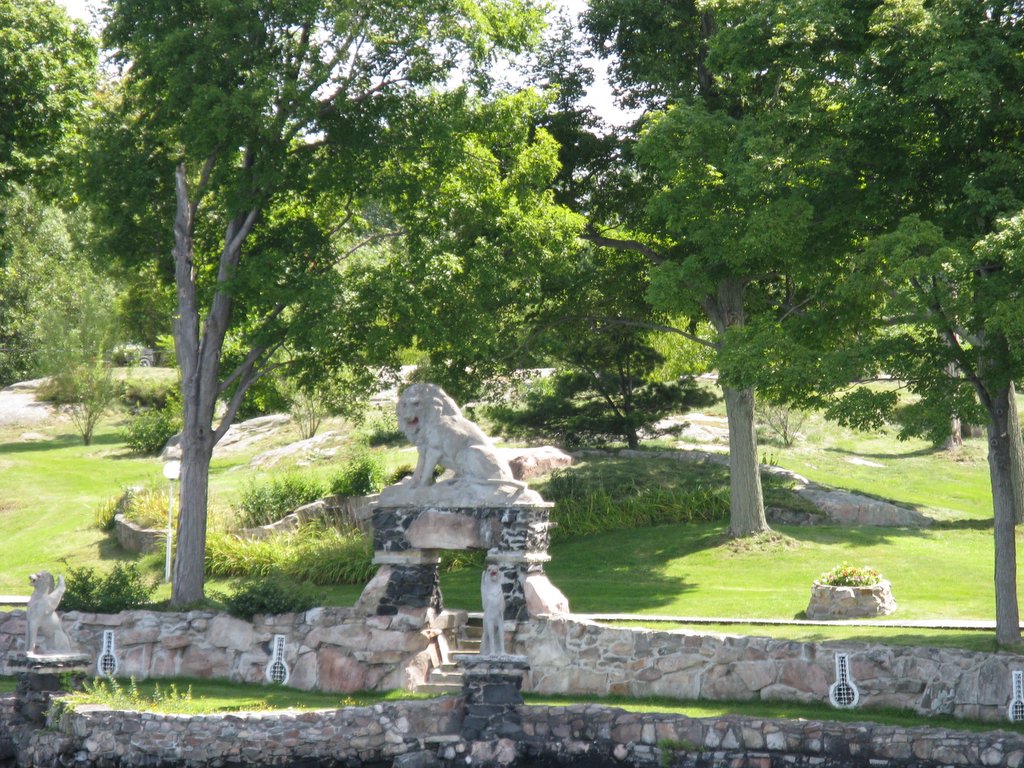
Classical Statuary on a grand scale. Here's a formidable guardian of the garden. Boldt Castle, 1000 Islands
Another example of classical statuary on a grand scale. Though not to everyone's taste, there's no denying how tasteful these three beauties are. From a veritable mansion in Toronto.
And a third example, of classical statuary on a grand scale. Once again, a truly magnificent example of garden ornament, this time incorporating the statuary with a water feature. How envious I am! IBID
This beautiful little statue, sitting quitely amongst the wisteria and sweet woodruff, is proof that you don't have to go big to have an impact. From a private oasis on Ward's Island, Toronto.
OK, perhaps a little too large and strange for an your ordinary garden, but you've got to admit it does add interest! From the grounds of the now defunct Fifth Town Cheesery, Prince Edward County
Simple and extremely tasteful. From an estate in Etobicoke.
One of my favorites. The juxaposition of this pendulous spruce against the verticles of the fencing is enhanced by the circular "window" cut in it.  The circular form is echoed by one round ball nestled amongst a plethora of irregular stones at its base, which serves to punctuate and complete the composition. An exquisite work of art. From another garden in Etobicoke.
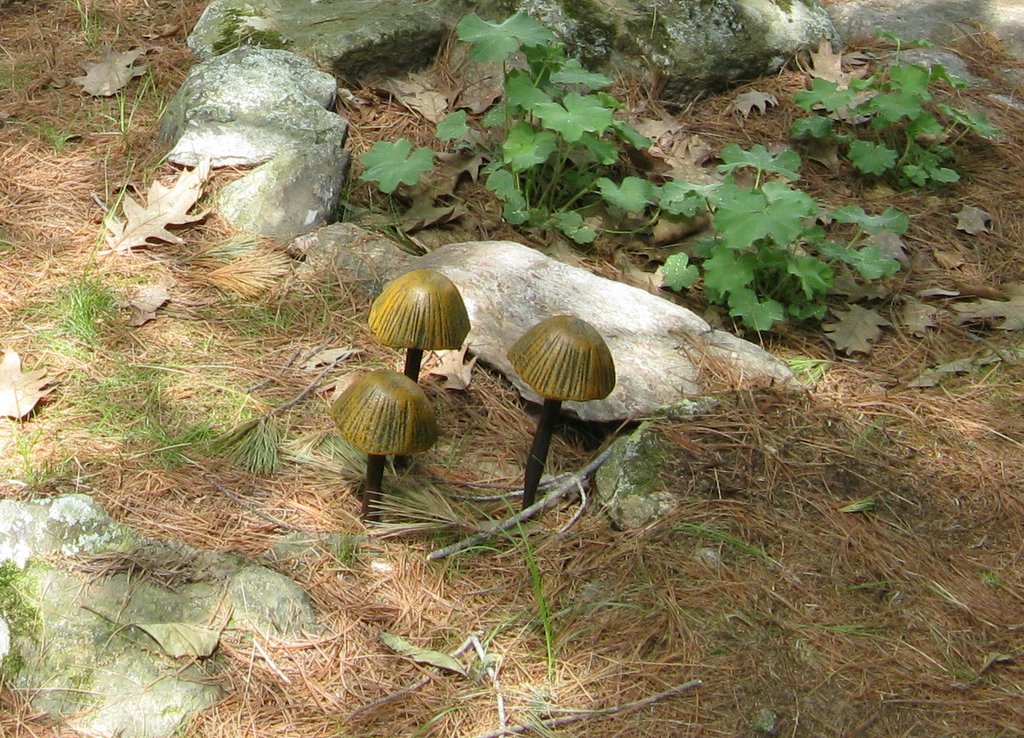
I've tried to gain inspiration for garden ornaments for Kelly Gardens from magazines, garden centres and gardens that I have visited over the year.  I'm a fan of natural ornament myself.  I don't think you will be seeing garden gnomes or pink flamingoes at Kelly Gardens. But natural looking doesn't mean it has to be boring. Have a look at these metal mushrooms we bought this year in Merrickvile at a yarn store (go figure!).

At a distance they look very realistic. But you could give your toe a nasty stub on them if you're not careful.

Last year at the Montreal Botanical garden in their gorgeous catus/succulent house, we spotted a wonderful use of a natural object which was probably placed to add verisimilitude, but it sure did turn out to be decorative too.

Take a look at this.
This bovine skull is playful, and at the same time very fitting. You can almost believe you are in the desert rather than a green house!

When we visited again this Spring, we noticed someone had added a plant in a very clever way.

OK, so it isn't exactly the same skull, but you must admit it's an improvement from the earlier incarnation. Adding the succulent just adds to the playfulness. Bravo!

Wow, I just had to get me one of those!


Meet Geraldine...

Photo op time. We put her under the Sedge just for fun, but I think you'll agree that she looks a lot better with the driftwood in this garden. She comes in for the winter, as our boys think she's really cool, and we wouldn't want her to go astray. (That's a bit of a non-sequiter. Let me explain - Teenage boys think Geraldine is cool, therefore may wish to liberate her. As we visit so rarely, we aren't around to make sure she doesn't get "appropriated".  Therefore, she's being taken in for the winter.)  When we move up eventually, we will keep her out. After all, I'm looking forward to taking her photo when she's covered with snow.

Geraldine in the foreground and the lovely piece of found wood in the background. This bed is planted with echinacea, and blue fescue with some thyme and sage in the corners. I think the driftwood fits perfectly here with Geraldine.

I must admit I find it amusing (which is better than being outraged) at the price of drift wood you can purchase at garden centres. Luckily we have many dead trees at Kelly Gardens, and the ones that have been standing for a long time are oaks. that's an added bonus as the wood is hard and doesn't decay as fast as other woods do.

So, take a piece of dead tree and put it artistically in the garden, and Voila.

I haven't even touched on the whole world of Japanese Garden ornament, which I must admit we have started to acquire, but I'm very pleased with how our first foray into garden ornament has turned out, and the Lanterns will be featured in another post.
 
 
P.S. If anyone knows where we can get a pair of Temple Dogs, we would love to know as they would certainly be spectacular guarding the entrance to Kelly Gardens.
Tuesday, 31 July 2012

Thank you Readers

Recently I have been looking at other bloggers' work, and (dare I say) comparing it to my own.  All I can say is, thank you for coming. Amongst all the competition on the internet, I'm flattered that you make the effort to visit this blog.

There is so much eye-candy out there that I am, on the one hand, impressed by the quality and the beauty of the gardens, and, on the other, depressed, that Kelly Gardens is so young and currently not very photogenic.

And yet, here you are, my faithful readers, still visiting to see what has happened at Kelly Gardens.

A big thanks. And perhaps one day as our garden grows you will be rewarded for your faithful visits with some Kelly Garden's eye-candy. When it grows up.

Saturday, 30 June 2012

Stairway to Heaven Part 3. The Dock Stairway

If you remember, I had promised to continue the Stairway to Heaven post in Stairway 2

Looking down towards the lake. (If you remember, I used to like to sit on these steps and survey the lake).
 If you turn around, you face another set of steps.

Here you can really see the railway-tie step-building technique.

At the top of this stairway (which eventually leads down to the Dock) is one of our first gardening attempts, the Dock Stairway Garden (DSG).  Over the course of 5 years, David has dug out the grasses and debris between the existing rocks, shifting some and maneuvering others to create a pocket where a plant could be tucked.  The DSG is mosty situated to the left of these steps, however, if you look closely you can see a small planting of sempervivums on the right of the steps.

This technique is called "Developing a natural outcrop" (who'd have thought this is an actual technique!), and I will be showing you our progress in the next post.

Thursday, 21 June 2012

Bambi is no longer welcome here

One of the things I love about the area where Kelly Gardens is situated is the abundance of wildlife. I remember when we first used to go up and visit, we'd be hushed and awed when a deer and her fawns came up the drive in the early morning or evening. We'd rush to get the camera and shout in whispers and try not make sudden moves so we wouldn't scare the deer away.

Well, I think I'd scream blue murder now if I saw a deer in my garden. (Does this mean I'm now a real country person?). And I bet you can guess why the change of heart. We have just returned home from our first visit to Kelly Gardens this year. And what did we find?  The deer have used Kelly Gardens as a salad bar.

We really shouldn't have been surprised; after all, we know that deer have regular trails all over our property, we know they get hungry in the spring, and we know that they like to eat. We just didn't expect them to pull up all the adorable miniature Chamaecyparis that we planted last year, decide they didn't really like the taste, and spit them out down the hill! 

Bambi also decimated the Korean Fir, which had weathered a winter and grown a good 6 inches.
Abies Koreana "Horstmanns Silberlocke", planted June 2011
Here's what's left of the Korean Fir after Bambi had finished with it. Picture taken in May 2012.  I wanted to weep.

Here's the Picea orientalis "Tom Thumb" right after it was planted.
At purchase "Tom Thumb" was 7" wide  by 5 1/2" tall (credit, David's data base)
And here it is again after the deer had given it a hair cut. Luckily it is putting out some new growth, which is bright yellow/green.

David is of the opinion that I'm taking this loss far too seriously, and perhaps he has a point. I'll get over it, but meanwhile the fight to foil the deer is on. But I will probably still be in awe when I see the deer in the garden.


P.S. It wasn't all bad news. The deer left many things alone, including the Juniperus communis compressa. This gave us heart, and, more importantly a big clue... Bambi doesn't seem to like Juniper. Let's buy some more!


Juniperus communis compressa 9" tall by 3" wide at planting (May 2011) and very slow growing.
P.P.S. The deer also didn't spot the Japanese Maple, perhaps because it hadn't leafed out yet.
Shhhhh, let's keep that one a big secret.

Sunday, 17 June 2012

Butterflies really fly free

This year has been a wonderful year for butterflies in Southern Ontario. Partly due to the very mild winter (which has been blamed for the raise in many of the bug populations) and partly because of the winds, which gusted from the South in mid - April, allowing the butterflies to hitch a ride, we have been blessed with their presence.

In Toronto in early May, there were many sightings of butterflies.  A Red Admiral even flew into a street car I was riding one day after work. (Of course it could have been a Painted Lady, the colouration is very similar, and they all look a bit like Monarchs to me when they're flying by ... except of course, the Painted Lady and Red Admiral are smaller than the Monarch).
Red Admiral , Painted Lady and Common Buckey (photo credit, G. Richardson and A. Guidotti)
Up at Kelly Gardens at the end of May, the air was filled with Giant Swallowtails. We probably saw 3 a day!

Here's one having a rest on the lawn (I'm being sarcastic... we don't have a lawn).
And here's a Giant Swallowtail at the Montreal Botanical Gardens.

Although I loved seeing the butterflies at the MBG along with thousands of other people, I much prefer to see them in the wild.

Now don't forget, if you want to continue to see them, you need 3 things.

Firstly, you need plants with nectar to feed the butterflies. Species plants have more nectar than Hybrids.
Secondly, you need plants that the butterflies will lay their eggs on, (each butterfly has a preferred host plant) and third and perhaps most importantly ... know your caterpillars, because without caterpillars there will be no butterflies!

Painted Lady Caterpillar
Common Buckeye Caterpillar
Red Admiral Caterpillar
And the Giant Swallowtail caterpillar is so ugly, I don't want to post a picture of it. Call me squeamish, but I'm not fond of bugs.   It looks a bit like bird poop, except when it gets threatened and then it extends these red horns and gives off a nasty scent. And this ugly duckling becomes an exquisite butterfly. Go figure.

Tuesday, 22 May 2012

Don't blink or you'll miss it

Some of the most delightful flowers only open for a day before they die. The most common is the Hibiscus, which you can see in almost every supermarket floral department.

Today our Astrophytum bloomed. I had been watching the flower bud swelling on top of the catus, and warned David that it would be blooming any day now. We missed the opportunity to photograph it a couple of times last year, since we didn't know the bloom would only last a day and by the time we checked up on it after work, it had already closed.

Caught it this time though.  It is a hybrid and the cactus is about 1 1/2 inches wide by 1 inch tall.  At its peak the flower is as big as the cactus. It blooms a couple of times a year and it has no scent.


Monday, 21 May 2012

The Kelly Gardens Sign

David and I visit Kensington Market every Friday after work to do our grocery shopping. We've been going with great regularity for a couple of years now, and the people in the shops we frequent have come to know us.  We like it like that. It's somewhat old fashioned, but we enjoy having the connection of a small community in the midst of the big, anonymous city.

Often we have our supper at  the Tibet Cafe - a restaurant that serves a strange mixture of different foods; we always get the "momos"  - little dumplings filled with meat served in a light broth. Delicious.  It is  here we first saw the art of Sae Kimura, a lovely young artist from Japan who is visiting Canada for an extended stay. I loved her whimsical art and she had a little notice offering to do commissions. She offered to create something if you shared your dreams with her. It wasn't such a large step to think that she might be able to paint a new sign for our garden.

 We met with Sae, and showed her pictures of the lot, and the blog, and described some of the things that made our place special, and she went away and thought about it.

Pines and rocks are common on our lake front
A happy little frog having a rest on the bunkie window
A yellow swallow tail
We get lots of visitors on the bunkie windows.   Considering how voracious the appetite of dragon fly is, it is amazing that we don't fear them.


When we met again, she produced the lid of a metal drum (which she had found) on which to paint the sign - and a few sketches of how she imagined the sign would appear.We liked her proposal, and gave her the thumbs up to go away and create.

I knew she was talented, but little did I suspect she would come up with such a perfect image for Kelly Gardens. We had described some of the wildlife we saw and the many pine trees, and she incorporated all these elements into the sign... and as an added bonus, David and I are also included.

Close up to show detail
When we find a place to hang it, I'll post more pictures with the "Kelly Gardens" sign, in - situ.